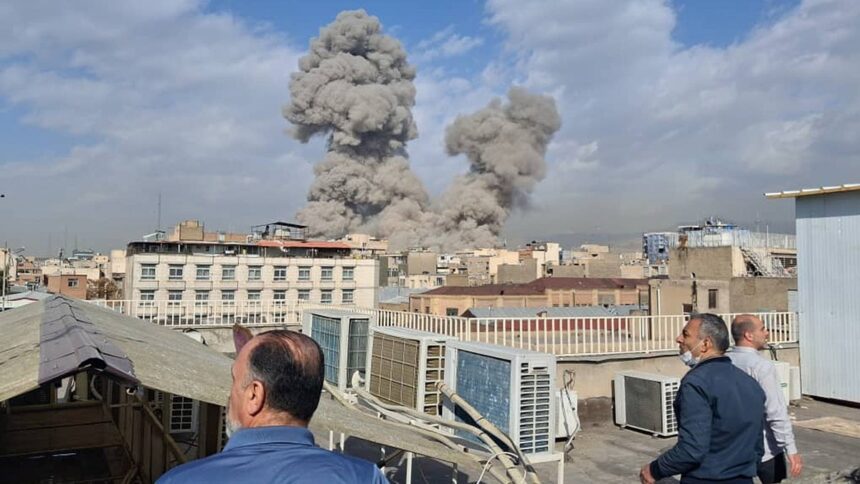
Wars are not defined by the tonnage of munitions expended or ships sunk. They are defined by whether military force serves a coherent political objective. One month into Operation Epic Fury, that principle remains unlearned.
On February 28, U.S. and Israeli forces launched the in the since Iraq. Irans navy has been gutted, its air defenses wrecked, and its . The administration is tallying strikes and sunken ships the way commanders in Vietnam tallied body counts. Those metrics told then-President Lyndon B. Johnson nothing about whether he was winning. They tell us nothing now.
Iran is still fighting. Despite losing over 150 naval vessels and its supreme leader in the opening strikes, the regime did not fracture. was installed as the supreme leader within days. This past week, the IRGCs navy commander was killed in a U.S. strike. No succession crisis followed. U.S. intelligence assessments confirmed the regime remains “intact but largely degraded.” Degraded is not defeated.
The escalation is accelerating. Secretary of War Pete Hegseth declared last week that Operation Epic Fury “is not an endless war” â and that same day, the Pentagon ordered 2,000 paratroopers from the 82nd Airborne Division to the theater, joining two Marine Expeditionary Units already en route. The 82nd is the Armys forced-entry division. Its primary mission under active planning appears to be the , Irans primary oil export hub. No one has publicly articulated the exit strategy.
The munitions math is brutal. The first six days cost at least $11.3 billion in weapons alone. The U.S. builds only 96 THAAD interceptors per year; a quarter of the entire stockpile was consumed in last years 12-day campaign. Iran produces over one hundred ballistic missiles per month. We build six or seven interceptors in the same period. Gen. Dan Caine, chairman of the Joint Chiefs of Staff, warned before the war that a protracted campaign would drain stockpiles critical to deterring China. A war that cannot be sustained arithmetically cannot be won strategically.
The Strait of Hormuz carries 20% of the worlds oil supply. Its near-closure since February 28 has produced the largest since the 1970s. Goldman Sachs modeled that oil averaging $110 per barrel for one month raises U.S. inflation to 3.3% and trims GDP growth to 2.1%. Brent crude hit $126 at its peak.
More consequential, and less reported, helium. facility â the worlds largest LNG plant â halted helium production and inflicted damage that will take years to repair.Â
Qatar supplies a third of the worlds helium. It is an irreplaceable input in semiconductor fabrication, space systems, and medical imaging. Without it, chip production stops. There is no synthetic substitute. This war has threatened the physical supply chain that underlies every advanced technology the U.S. economy and military depend on.
And here is the fact the administration is not leading with: Treasury Secretary Scott Bessent disclosed this past week that Irans financial system collapsed in December 2025 â the product of a maximum-pressure campaign launched a full year before Operation Epic Fury.Â
Iran entered this war already financially broken. It is still fighting. A regime that keeps fighting after its financial system has already collapsed will not be stopped by economic pressure alone.
There is no defined end state. Secretary of State Rubio declared every military objective is “being effectuated.” Those are kinetic metrics. They say nothing about what political condition the United States intends to produce or how it will know when the war is over.Â
Secretary Hegseth summarized U.S. strategy as “.” That is Clausewitz inverted. Clausewitz said war is the continuation of politics by other means. Hegseths formulation makes the bombs the diplomacy. That is not a strategy. That is a war without a political objective.
Tehran has rejected the U.S. 15-point ceasefire plan