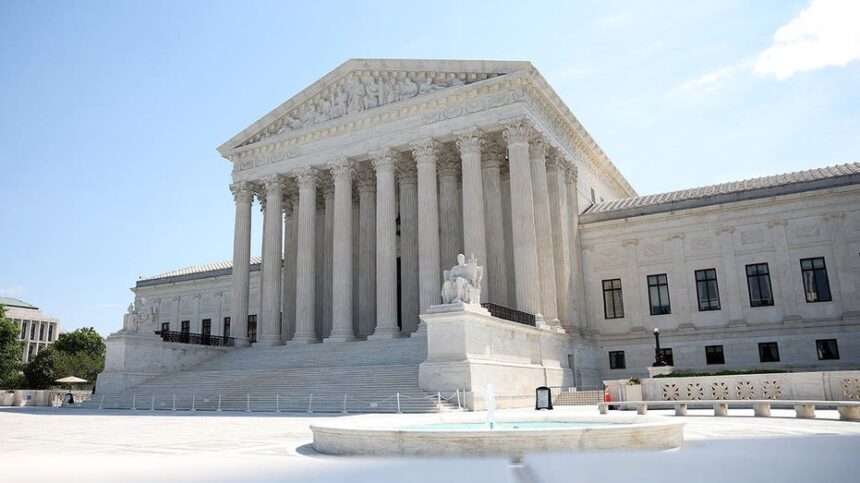
In 1863, as the Civil War raged and its result was not yet certain, Congress for the first time raised the number of justices on the Supreme Court to 10. The Tenth Circuit Act was approved on March 3, 1863. This was done in large part to allow Abraham Lincoln to nominate a strong Unionist justice to the Court, Stephen J. Field, on March 6, 1863. Field was confirmed on March 10, after Congress created a new Supreme Court seat.
Three years later, after the Unions triumph in the war, the assassination of President Abraham Lincoln and the beginning of a long, drawn-out era of Reconstruction, Congress passed a bill on July 23, 1866, that reduced the number of justices to seven through attrition and barred the filling of vacancies until that number was reached. This was done to prevent President Andrew Johnson from making any nominations to fill Supreme Court vacancies.
Just prior to this statutes passage, Congress had passed the Fourteenth Amendment on June 13, 1866, and formally transmitted it to the states for ratification on June 16, 1866. Ratification was not certain, nor was the defeat of Johnson in 1868. While the proposed Fourteenth Amendment was silent on the number of justices on the Supreme Court, the amendment explicitly guaranteed the citizens of the United States the right to “due process of law,” along with unenumerated privileges or immunities and the equal protection of the laws. The language of the amendments first section concludes: “No State shall make or enforce any law which shall abridge the privileges or immunities of citizens of the United States; nor shall any State deprive any person of life, liberty, or property, without due process of law; nor deny to any person within its jurisdiction the equal protection of the laws.”
REPUBLICANS FAIL TO EASE ONE OF TRUMP’S GREATEST FEARS AS SUPREME COURT MEASURE COLLAPSES
The original Constitution had been silent as to the number of justices on the Supreme Court, but from 1866 to 1869, a combination of three statutes and one amendment put a constitutional imprimatur on the number of nine. The Fourteenth Amendment was ratified on July 9, 1868, by the necessary number of states, and Secretary of State William Seward formally proclaimed the Fourteenth Amendment as part of the Constitution on July 28, 1868.
On March 2, 1867, while the new amendment was pending ratification or rejection, Congress passed a Reconstruction Act that obliged any state in the defeated Confederacy to ratify the Fourteenth Amendment before that states representatives could be admitted to Congress.
Less than a year after ratification and certification of the Fourteenth Amendment, Congress completed the work of the Reconstruction Era with regard to the Supreme Court with the passage of the Judiciary Act of 1869.
That act first passed in March 1869, but outgoing President Johnson pocket-vetoed the bill. Congress promptly passed it again, and the new President, Ulysses S. Grant, promptly signed it. That law completed the work of the Fourteenth Amendment and fixed the Supreme Court at nine members, where it has remained for 157 years.
There is an excellent argument that this sequence of events over three post-war yearsâa proposed amendment passing Congress, then a statute tying the hands of Johnson, then a statute requiring ratification as a precondition of admission to the Union, followed by ratification of the amendment and then the final statute on t