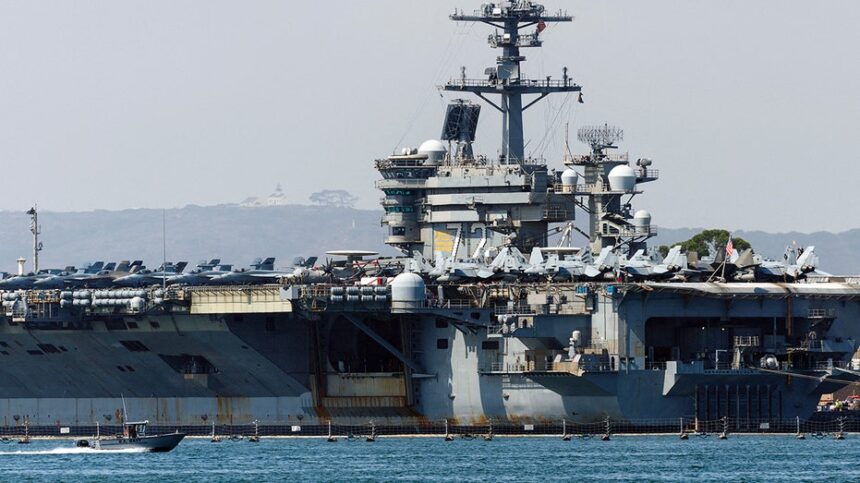
The most strategically revealing military move in the Iran war this week isnt another strike on Tehran. It is an American aircraft carrier leaving the Pacific. The USS George Washington is heading toward the Middle East to relieve the USS Abraham Lincoln, whose overall deployment has exceeded 260 days, including more than 240 uninterrupted days at sea. The move could leave the Pacific without a U.S. carrier for an unknown period.
That does not mean China is preparing to attack Taiwan. It means the United States is making a real strategic tradeoff: a carrier reinforcing the Middle East cannot simultaneously deter in the Western Pacific. America has global reach, but its forces are not infinite, and geography still imposes choices.
The same point was visible in Adm. Brad Coopers just-completed 10-day trip through six Middle Eastern countries. CENTCOM says more than 50,000 American service members are now operating across the region. Iran is consuming ships, aircraft, munitions, logistics and command attention at the same time Washington says the Indo-Pacific must remain a priority.
That is the strategic dilemma. The question is no longer simply whether the United States has enough military power to continue operations against Iran. We do. The harder question is whether we are allocating that power in a way that matches our declared priorities.
The 2026 National Defense Strategy is unusually clear on this point. It calls for a strong denial defense along the First Island Chain and places deterring China among the Pentagons top priorities, expecting allies to shoulder more responsibility elsewhere. Whatever one thinks of that approach, it is strategy because it makes choices.
Now events are testing whether Washington is prepared to live by those choices.
This is not the familiar debate over whether America can “fight two wars.” That phrase is too crude. The United States remains capable of fighting in more than one theater. The real problem is deterrence: Can we sustain a demanding conflict in the Middle East while keeping enough ready combat power elsewhere to persuade China that this is not its moment to attack Taiwan?
THREE KEY REASONS WHY AMERICA CANNOT AFFORD TO LOSE TAIWAN TO COMMUNIST CHINA
Deterrence does not require an adversary to believe we are invincible. It requires him to believe the cost of acting now is greater than the potential gain. Beijing does not need to conclude that America has become weak. Chinese planners need only ask whether American forces, munitions, maintenance capacity and political attention are tied down enough elsewhere to alter the risk of acting in the Pacific.
History offers useful warnings, not because 2026 replays 1941 or 1950, but because strategy has always meant matching ends, ways and means.
Britain learned that lesson painfully before Singapore fell on February 15, 1942. London carried military commitments across Europe, the Mediterranean, the Middle East and Asia while its